
Founded 1923
- Presenter

94th Annual Congress Tom Rielly Display
Display by Maureen Mathieson
I feel very honoured by being invited to do this display as I met Tom Reilly when I attended the Dundee Philatelic Weekends where he was one of the founding committee members and also seeing his invited displays as a member of Lanarkshire Philatelic Society..
I joined Lanarkshire Philatelic Society in 1985. and was President in 2001 and 2022. I joined Glasgow Thematic in 2003, was President in 2005 and have been Secretary and Treasurer since 2009. I joined the Caledonian Society in 2006 and was President in 2021 during Covid (Zoom meetings), have also been a member of Alba and Paisley Societies and am a member of the Glasgow Society.
I began saving stamps as an adult by collecting Swiss stamps as my son had begun work in Geneva then became interested in Thematic collecting by looking in the Lanarkshire Exchange Packet. At first I thought of flowers as a subject but decided there were too many different types then chose Butterflies and Moths only to discover that there were lots of them and they too had Latin names but I was hooked!!
Frame 1: An introduction to the Victorian stamp collectors who toured the world and saved examples in glass cases for display.
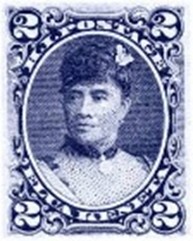
This is the first stamp to show a butterfly. It was issued by Hawaii in 1891 and is a portrait of Queen Liliuokalani.
The next section shows the differences between butterflies and moths and shows examples of the various stages in their lives from egg, caterpillar or larvae, pupa and the emerging adult butterfly.
Frames 2-3: Nymphalidae (Brushfoots and allies). This group includes common butterflies like the Peacock and Painted Lady which are found in Britain and the more unusual Great Eggfly where the male and female are entirely different.
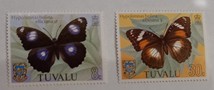
This group also includes the famous Monarch butterfly which migrates every year from the Great Lakes area of Canada some 3000Km to Mexican forests where it overwinters, and the butterfly which shows the number “88” on its underwing
Frame 4: Pieridae: (Whites and yellows) This includes the Orange Tip and Large White and the Clouded Yellow which has pink legs and antennae.
Frame 5: Polymmatinae (Blues and coppers) A subgroup of a species of 6000 butterflies. They include the Dark Brown Argus found in Scotland and the Large Blue which has been reintroduced in Britain after becoming extinct in 1979.
Theclinae (hairstreaks) – another of the same large species. mostly found in America, the West Indies and the Far East.
Frames 6-7: Papilionidae (Swallowtails and Birdwings) including the Swallowtail which can be found in southern Britain. In America the same butterfly is known as the Artemesia Swallowtail. Some of the birdwings on show have a winsgspan of up to 150mm including the Australian Richmond birdwing. The Apollo butterfly has been found in the higher Alps and one variety is found in the Himalayas. Queen Victoria’s Birdwing was thought to be a bird when it was shot down 150 years ago.
Hesperidae (Skippers): originally classified as butterflies, this group show more similarities to moths and are now separated from true butterflies in classification.
Frames 8-9: MOTHS. Tiger Moths - 10,000 species: Owl Moths – a small species: Owlets, Millers and Underwing Moths – about 12,000 species, Emperor and Silkworm Moths – 1000 species including the Atlas Moth which is the biggest moth in body size.
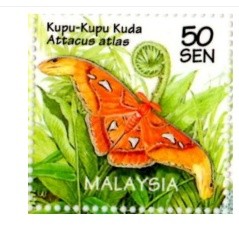
Hawk Moths including the Hummingbird Hawk Moth and the Death’s Head Moth, Slug Moths with a very scary caterpillar, the Sunset Moth and 2 moths whose Caterpillars have a Government Health Warning and must be reported if sighted.
Frame 10: “Flights of Fancy” Tuck’s Butterflies on the Wing series. Postcards were issued in the 1940s? some outlines of the butterflies were perforated and could be bent upwards to give the idea of flight.
Below is a picture of Maureen Mathieson receiving her Tom Rielly medal from President Graham Mill.

This page was last modified on 22nd April 2024
Copyright (c) 2016-2025 Association of Scottish Philatelic Societies.
The documents on this website are for informational and non-commercial or personal use only.
